My child has severe abdominal pain - when should I worry?
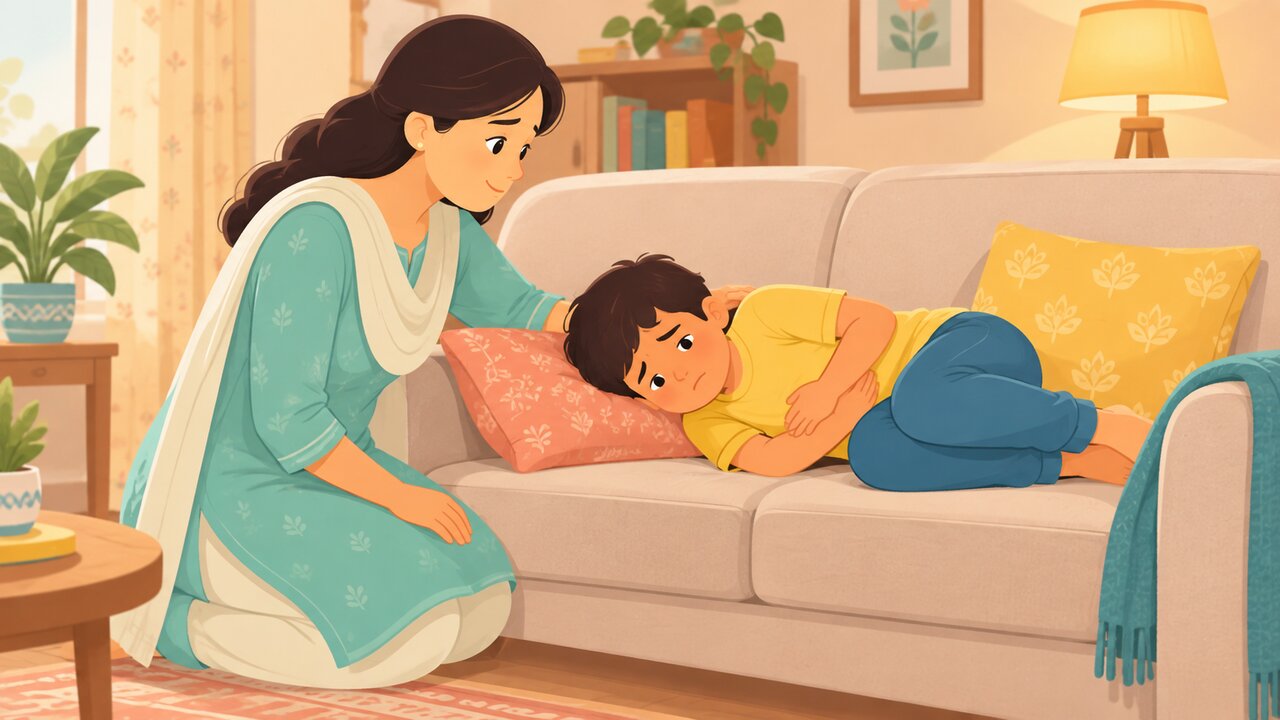
Quick answer: Most tummy aches in children are minor - gas, constipation, a mild virus - and settle on their own. Worry when pain is severe, keeps getting worse over a few hours, moves to the right lower belly, comes with green vomit or blood, or when your child refuses to eat, play or move. And one rule every parent of a boy should know: sudden severe testicle pain is a surgical emergency - go straight to the ER.
🟢 GREEN - You can usually watch at home when
- The pain is mild, comes and goes, and your child plays, eats and moves around normally between episodes.
- Your child passes gas or stool and feels better, and has no fever, vomiting or swelling.
🟡 YELLOW - Call your paediatrician today if
- Tummy pain keeps coming back over days, or your child complains of pain with passing urine.
- There is constipation, mild fever, or reduced appetite but your child is otherwise well.
- A sore throat with tummy pain - throat infections can cause belly pain in children, but it deserves a look.
- The pain wakes your child at night repeatedly.
🔴 RED - Go to the emergency room NOW if
- Pain that steadily gets worse over 3-5 hours, or pain so severe your child doubles over, refuses to walk, or wants to lie perfectly still.
- Pain that starts around the belly button and moves to the right lower belly, with your child refusing food - even their favourite food. This is the classic appendicitis pattern. It is rare under age 3, but it happens.
- A baby or toddler (usually 6 months to 2 years) with bursts of intense crying, legs pulled up to the chest, vomiting, and dark, mucus-filled, bloody stools - this can be intussusception, where the bowel slides into itself. Between attacks the child may seem oddly fine. This is the most common abdominal emergency in children under 2.
- Sudden severe pain or swelling in a boy's testicle or groin - this can be testicular torsion, a twisted testicle losing its blood supply. If it is corrected within about 6 hours, the testicle is saved in over 90% of cases; after 24 hours, it is usually lost. Do not wait "to see if it settles".
- Green (bile-coloured) vomiting, a swollen hard tender belly, or blood in vomit or stool.
- Severe belly pain after an injury - a fall, a bicycle handlebar hit, a road accident.
- Your child is drowsy, pale, sweaty, or faints with the pain.
🆘 SOS - What to do while you get help
- Let your child rest in whatever position is most comfortable - often curled on their side.
- Offer small sips of water or ORS; do not push food.
- Note the time the pain started, where it started, and whether it is moving or worsening - this timeline genuinely helps the doctors.
- You may give paracetamol for pain or fever in the dose your paediatrician has advised for your child's weight.
❌ DO NOT
- Do not give laxatives, enemas or "purge" remedies for undiagnosed severe belly pain - if the appendix or bowel is the problem, these are dangerous.
- Do not give a big meal or force-feed a child with worsening pain - they may need anaesthesia for tests or surgery.
- Do not wait overnight with pain that is clearly worsening - the surgical causes are all easier to treat early.
- Do not ignore a boy's testicle pain because he is embarrassed to talk about it - teach boys that genital pain is never something to hide.
What is happening and why
The useful rule of thumb: harmless tummy aches come and go and the child plays in between; dangerous ones get steadily worse and take the child's appetite and play away. The surgical causes each have a signature. Appendicitis pain migrates to the right lower belly and kills the appetite. Intussusception comes in waves of screaming with the legs pulled up, in the 6-month to 2-year age group. Testicular torsion is sudden, severe, and a race against a 6-hour clock.
Doctors sort these out with an examination and usually an ultrasound - painless and quick - so "getting checked" is far less dramatic than parents fear, and far safer than waiting.
This page is for first-aid education and does not replace examination by a doctor. In an emergency, call 108 or 112.
Sources (last checked 13 Sep 2026)
- AAP, "Abdominal Pain in Children" - www.healthychildren.org/English/health-issues/conditions/abdominal/Pages/Abdominal-Pain-in-Children.aspx
- AAP, "Abdominal Pains in Infants" (intussusception, pyloric stenosis) - www.healthychildren.org/English/health-issues/conditions/abdominal/Pages/Abdominal-Pains-in-Infants.aspx
- AAP, "Testicle Pain & Testicular Torsion: Why It's an Emergency" - www.healthychildren.org/English/health-issues/conditions/genitourinary-tract/Pages/testicular-torsion.aspx
Reviewed and approved by Dr Anjana Alekhya, MD (Paediatrics) · Published 13 September 2026