My child may have swallowed a medicine, chemical or poison - what do I do?
Quick answer: Do not wait for symptoms and do not make your child vomit. Call for poison advice immediately - in India, the National Poisons Information Centre (AIIMS, New Delhi) is toll-free 1800-116-117, 24x7 (also 011-26589391 / 011-26593677). If your child collapses, has a seizure, has trouble breathing, or cannot be woken, call 108 immediately. Bring the packet or bottle with you.
First: make the scene safe
Move the poison away from your child and any other children, and have your child spit out anything still in their mouth - do not make them vomit. If it is a gas, spray or fumes, get your child into fresh air. If it touched the skin, remove the clothing that has the spill and rinse the skin with running water for at least 15 minutes. If it went into the eyes, rinse with room-temperature running water for at least 15 minutes, letting the water run from the nose side of the eye outward.
🔴 RED - Call 108 / go to the ER NOW if
- Your child is unconscious, unusually drowsy, or difficult to wake.
- Your child has a seizure, trouble breathing, or blue lips.
- Your child swallowed (or may have swallowed) a corrosive: toilet cleaner, drain cleaner, acid, bleach, battery liquid, or anything that burns. Signs: burns around the mouth, drooling, crying with swallowing.
- Your child swallowed a hydrocarbon: kerosene, petrol, paint thinner, turpentine, lamp oil. Even a small sip is dangerous if it goes into the lungs, and vomiting makes that far more likely.
- Your child swallowed someone else's heart, blood pressure, diabetes or psychiatric medicine, even a single tablet.
- You simply do not know what or how much was taken.
🟡 YELLOW - Call the poison centre (1800-116-117) right away, then your paediatrician, if
- Your child is fully awake and normal, but swallowed a small amount of a household product, plant, cosmetic, or medicine.
- The poison centre will ask exactly what was taken, how much, when, your child's weight and age, and any symptoms. They will tell you whether home watching is safe or you need the ER. Do not guess this yourself.
What information to collect (do this now, it saves time later)
- The exact name of the product or medicine - bring the bottle, strip or packet.
- How much is missing (count the tablets, estimate the liquid).
- When it happened.
- Your child's age and weight.
- Any symptoms so far.
🆘 SOS - What to do while you get help
- Keep your child lying on their side if they are drowsy or vomiting.
- Do not give anything else by mouth until you have spoken to the poison centre or a doctor.
- If your child stops breathing, start CPR if you know how and tell the 108 operator.
❌ DO NOT
- Do not make your child vomit - not with fingers, salt water, mustard water or anything else. Vomiting a corrosive burns the food pipe a second time; vomiting kerosene or petrol sends it into the lungs. Syrup of ipecac is no longer recommended anywhere.
- Do not give "home antidotes" - no activated charcoal from the chemist unless a doctor tells you, no lemon juice for alkalis, no baking soda for acids.
- Do not wait to see if symptoms appear. Many poisons act slowly, and early treatment is what works.
- Do not treat your child yourself at home without the poison centre or a doctor saying it is safe.
What is happening and why
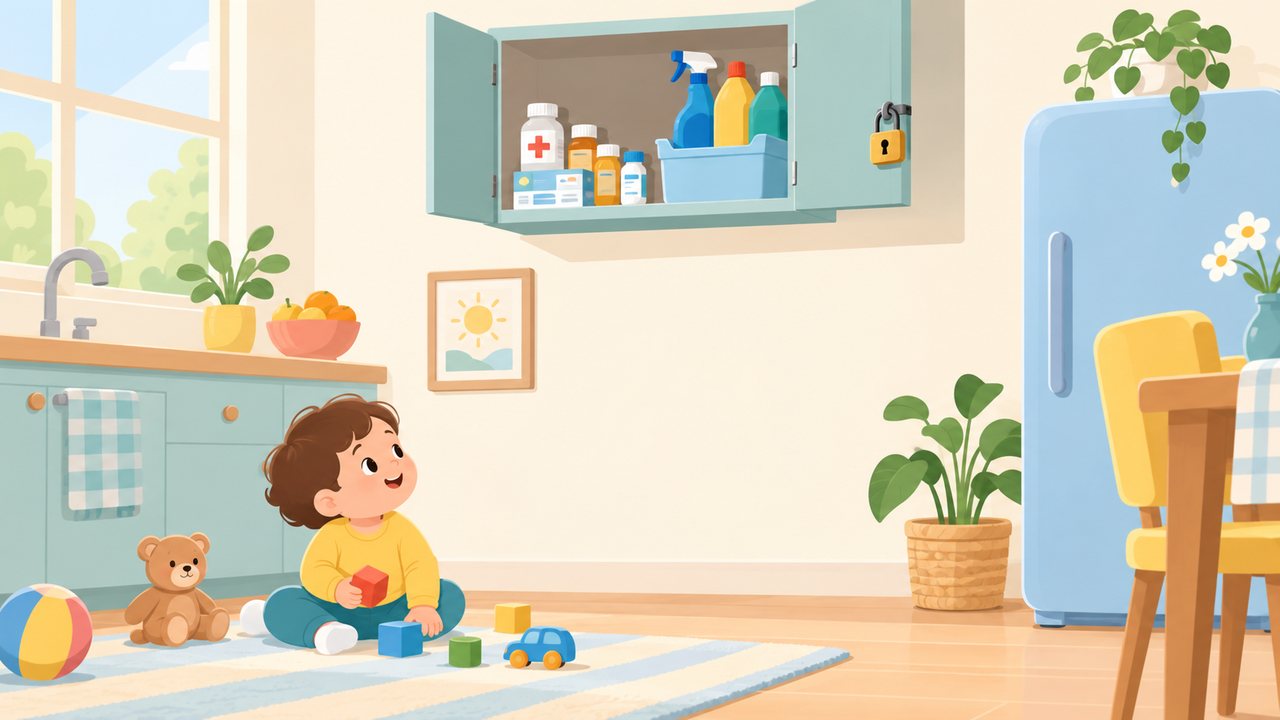
Most childhood poisonings happen at home, in minutes, while a parent's back is turned - medicines on a bedside table, cleaners stored in soft-drink bottles, kerosene in water bottles. The dangerous pattern in India includes kerosene and other hydrocarbons (lung injury if vomited), corrosive household cleaners (food-pipe burns), and adult medicines (heart and diabetes tablets can drop a child's heart rate or blood sugar dangerously). This is why the rules are counterintuitive: the parent's job is not to empty the stomach, but to get expert advice fast and stop further harm. Store all medicines and chemicals locked, high up, and always in their original containers.
This page is for first-aid education and does not replace examination by a doctor. In an emergency, call 108 or 112. Poison advice (24x7): National Poisons Information Centre, AIIMS - 1800-116-117 (toll-free).
Sources (last checked 13 Sep 2026)
- National Poisons Information Centre, AIIMS New Delhi (24x7 helpline and advice) - www.aiims.edu/index.php/en/npic_intro
- AAP, "Poison Prevention & Treatment Tips for Parents" (first aid: do not induce vomiting, no ipecac, skin and eye rinsing) - www.healthychildren.org/English/safety-prevention/all-around/Pages/Poison-Prevention.aspx
- AAP, "When Your Child Needs Emergency Medical Services" - www.healthychildren.org/English/health-issues/injuries-emergencies/Pages/When-Your-Child-Needs-Emergency-Medical-Services.aspx
Reviewed and approved by Dr Anjana Alekhya, MD (Paediatrics) · Published 13 September 2026