A snake bit my child - what should I do right now?
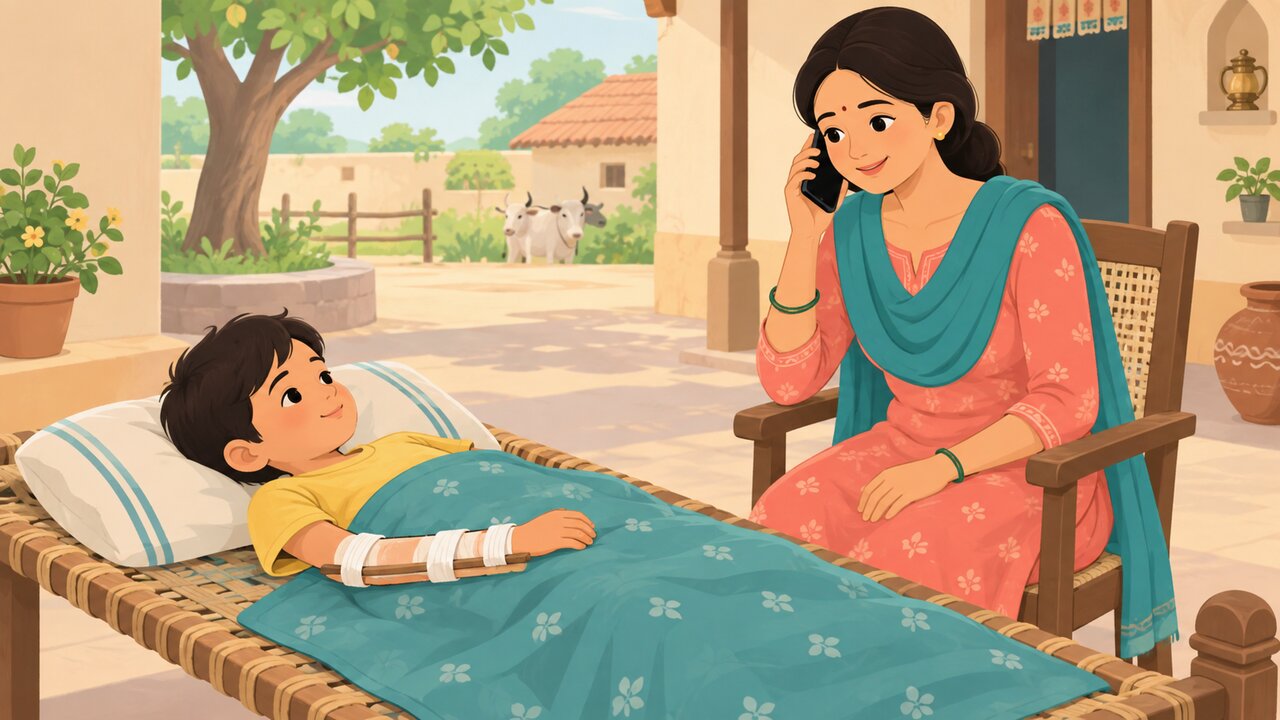
Quick answer: Keep your child as still and calm as you can, immobilize the bitten arm or leg like a broken limb (held at or below heart level), remove rings, watches and tight clothing near the bite, and get to a hospital with anti-snake venom (ASV) immediately - call 108. Do not cut the wound, do not suck it, and do not tie any tight band or tourniquet. Every snakebite goes to hospital, even with no symptoms.
🔴 RED - Every snakebite means hospital, NOW
- Go immediately even if there are no symptoms. Around 70% of bites are from non-venomous snakes, and many venomous bites inject little or no venom ("dry bites") - but you cannot tell which is which at home. Krait bites, in particular, may leave almost no visible marks and still be deadly hours later.
- On the way, watch for signs of venom: swelling creeping up the limb, pain at the bite, bleeding from the gums or the wound that won't stop, vomiting, drooping eyelids, blurred or double vision, difficulty swallowing or speaking, drowsiness, or any breathing trouble. Tell the doctors exactly when these started.
- Anti-snake venom is the only specific treatment, and it works best when given early. ASV is stocked at government hospitals and most larger hospitals.
🆘 SOS - What to do right now, step by step
- Reassure your child. Fear speeds the heart and spreads venom faster. Tell them most bites are not deadly and help is coming - around 70% of snakebites are from non-venomous species.
- Immobilize the bitten limb the way you would a broken one - a splint or sling made from a stick, cloth or bandage, held snug but never tight enough to block blood flow. Keep the limb at or below the level of the heart.
- Remove rings, bangles, watches, anklets, shoes and tight clothing near the bite before swelling makes that impossible.
- Keep the child lying down and carry them - do not make them walk.
- Get to the hospital fast by the quickest safe transport you have - do not wait arranging a "perfect" ambulance. If possible, call 108.
- Note what the snake looked like, or photograph it from a safe distance. Do NOT try to catch or kill it - a second bite is a real risk, and doctors can treat effectively without the snake's body.
❌ DO NOT
- Do not tie a tight band, rope, belt or tourniquet above the bite - these do not stop venom and can destroy the limb.
- Do not cut the wound or suck out venom, and do not apply ice, chemicals, herbs or "snake stones" - all of these cause harm and delay real treatment.
- Do not try to catch or kill the snake, and do not waste time with a traditional healer or waiting for symptoms to declare themselves - the hospital comes first.
- Do not give your child alcohol, and do not give anything to eat or drink on the way if they are drowsy or vomiting.
- Do not let anyone inject ASV outside a hospital - it needs medical supervision.
What is happening and why
India's dangerous snakes are mainly four: the cobra and krait (nerve venom - drooping eyelids, difficulty swallowing, breathing failure) and Russell's viper and saw-scaled viper (blood and tissue venom - swelling, bleeding, clotting failure). Venom spreads through the body's fluid systems, which is why movement is the enemy and stillness the first treatment. Children are bitten less often than adults but get sicker faster because the same venom load sits in a smaller body.
The treatment is the same polyvalent ASV everywhere in India, started as soon as a doctor sees signs of envenomation - so the entire first-aid plan has one goal: deliver a calm, still child to that doctor as fast as possible, with nothing done on the way that makes things worse.
This page is for first-aid education and does not replace examination by a doctor. In an emergency, call 108 or 112.
Sources (last checked 13 Sep 2026)
- IAP Textbook of Pediatrics, "Snakebite" chapter (first aid: reassure, immobilize, get to hospital, tell the doctor; tourniquet and cutting harms; polyvalent ASV), Indian Academy of Pediatrics - iapindia.org/pdf/Ch-102-Snakebite.pdf
- AAP, "Snake Bites: Symptoms, First Aid & Treatment" - www.healthychildren.org/English/health-issues/conditions/from-insects-animals/Pages/Snake-Bites.aspx
Reviewed and approved by Dr Anjana Alekhya, MD (Paediatrics) · Published 13 September 2026