My baby fell off the bed - do I need to panic?
Quick answer: Take a breath - falls from beds and sofas are one of the most common accidents of the first year, and most cause fright and a bump, not injury. The signs that mean go to the ER now: your baby cannot be consoled, vomits repeatedly, refuses to feed, looks very drowsy or cannot be woken, has a seizure, or one pupil looks larger than the other. Any fall you did not see, or any fall in a young baby that was more than a light bump, deserves at least a same-day call to your doctor.
🟢 GREEN - You can usually watch at home when
- Your baby cried immediately, settled within about 10 minutes, and is now feeding, moving all limbs and behaving normally.
- There is a small soft swelling on the scalp but nothing else - scalp bumps look dramatic and are usually harmless.
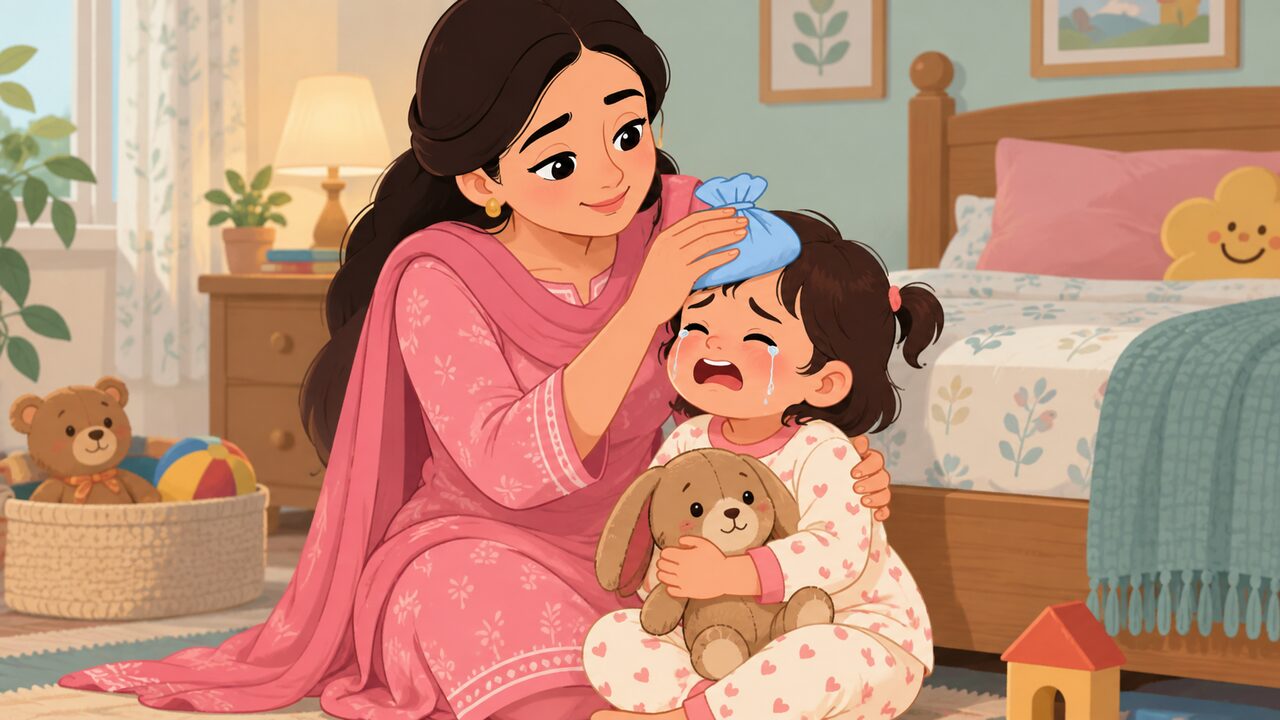
- Apply a cold compress (a cloth-wrapped ice pack) for 20 minutes for the swelling, and watch closely for 24-48 hours.
🟡 YELLOW - Call your baby's doctor today if
- You did not see the fall, or the fall was more than a light bump - off a changing table, from an adult's arms, or onto a hard floor.
- Your baby is under 6 months - small babies have softer skulls and cannot tell you how they feel, so the threshold for a check is lower.
- Over the next day or two your baby seems off - crankier or clingier than usual, sleeping or feeding differently. Behaviour change is how babies show a concussion.
- The swelling feels soft and squishy and keeps growing, or crosses a large part of the head.
🔴 RED - Go to the emergency room NOW (call 108 if severe) if
- Your baby will not stop crying and cannot be consoled.
- Your baby will not nurse or eat.
- Repeated vomiting or nausea.
- Your baby looks very drowsy or cannot be woken.
- A seizure, abnormal jerking, or the body going stiff.
- One pupil (the black centre of the eye) larger than the other.
- A fall from more than your own height, onto a hard surface, or any fall with a dent in the skull, bleeding that won't stop, or clear fluid from the nose or ears.
🆘 SOS - What to do for the next 24-48 hours
- Stay with your baby for the first 24 hours and keep things calm - no rough play.
- Cold compress on any swelling, 20 minutes at a time.
- Sleep is allowed. The old advice to keep a baby awake after a head bump is outdated - the AAP says sleep helps the brain heal, and you do not need to wake your baby periodically unless your doctor tells you to. Do check every few hours that your baby breathes normally and rouses enough to respond to you.
- For pain, only paracetamol in the dose your doctor has advised for your baby's weight.
❌ DO NOT
- Do not leave your baby alone on a bed, sofa or changing table again, even for seconds - most of these falls happen in the moment a parent turns away.
- Do not shake or roughly handle your baby to "wake them up".
- Do not give any pain medicine other than paracetamol unless a doctor advises it.
- Do not stop watching because your baby cried right away - the danger signs can appear hours later, which is what the 24-48 hour watch is for.
What is happening and why
Babies are top-heavy: their heads are large compared to their bodies and their neck control is still developing, so when they topple, they tend to go head-first. Their skulls are also softer and thinner than an older child's. That combination is why babies get concussions more easily - and why their signs are behavioural rather than verbal: a concussed baby cannot say "my head hurts"; they become inconsolable, refuse feeds, sleep differently, or seem not themselves.
The emergency list above catches the injuries that matter - bleeding or swelling inside the skull - and those signs almost always declare within the first day or two, which is the reason for the watch period rather than an automatic hospital run after every tumble.
This page is for first-aid education and does not replace examination by a doctor. In an emergency, call 108 or 112.
Sources (last checked 13 Sep 2026)
- AAP, "Concussions in Babies: What to Do If Your Infant or Toddler Hits Their Head" (emergency signs list; behavioural signs; sleep advice) - www.healthychildren.org/English/health-issues/injuries-emergencies/Pages/concussions-in-babies-what-to-do-if-your-infant-or-toddler-hits-their-head.aspx
- AAP, "Head Injury in Children" - as covered on our head injury guide - www.healthychildren.org/english/health-issues/injuries-emergencies/pages/head-injury.aspx
Approved for publication by Dr Anjana Alekhya, MD (Paediatrics) · Based only on AAP/IAP guidance · Published 13 September 2026