My child fell and hit their head - should I go to the ER?
Quick answer: Most head bumps in children are minor. The danger signs to act on immediately are: losing consciousness at any point, vomiting more than 2-3 times, a seizure, confusion or slurred speech, a headache that keeps getting worse, being hard to wake, unequal pupils, blood or watery fluid from the nose or ears, or weakness in an arm or leg. Any of these means go to the ER now. And for any baby under 2 years, call your doctor for anything more than a light bump - small children cannot tell you how they feel.
🟢 GREEN - You can usually watch at home when
- Your child is over 2 years old, was not knocked out, cried from pain or fright but settled within about 10 minutes, and is now walking, talking and acting normally.
- There is a small swelling ("egg") on the scalp but your child is otherwise completely normal.
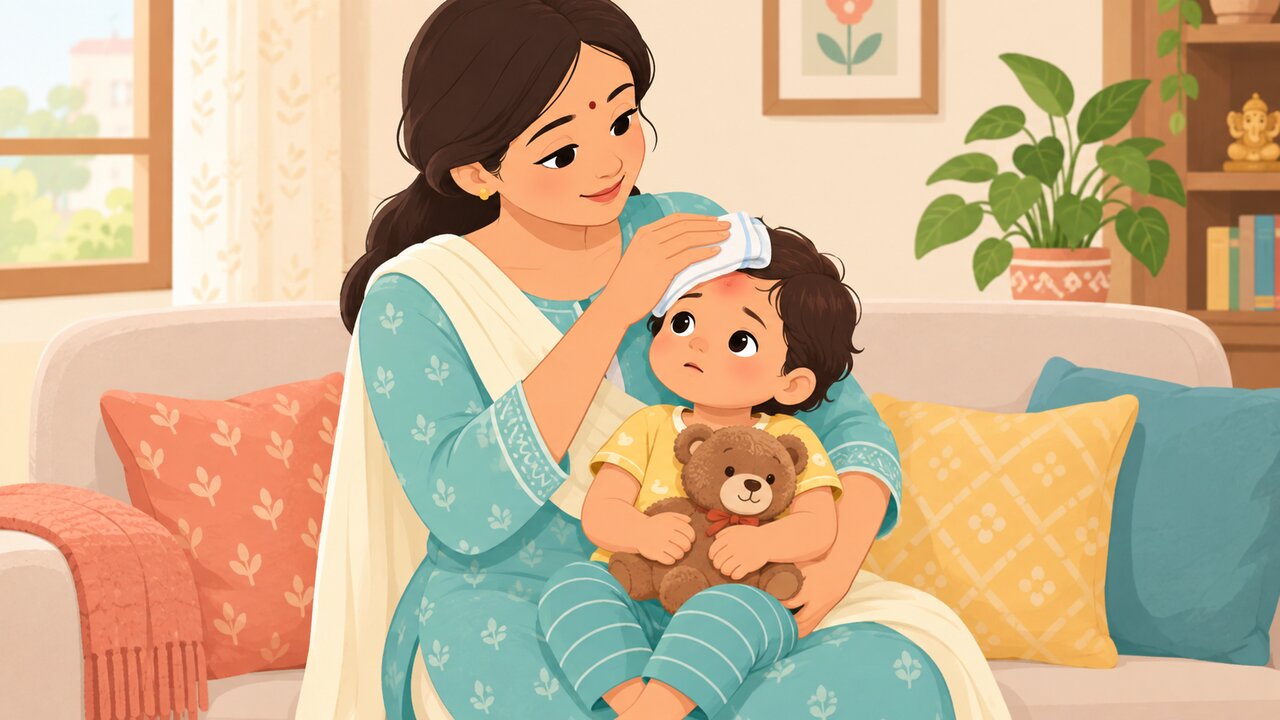
Apply a cold compress for 20 minutes for the swelling, and watch your child closely for the next 24-48 hours - signs of a more serious injury can be delayed.
🟡 YELLOW - Call your paediatrician today if
- The injury was anything more than a light bump - a fall from a bed or higher, a hard hit, or you did not see exactly what happened. Your doctor will want to know when and how it happened and how your child is feeling.
- Your child is under 2 years old - the rules above were written for older children, and babies need a lower threshold for a check.
- Your child has a bleeding disorder, bruises easily, or already has a nervous system condition.
- Your child seems "not quite themselves" over the next day or two, even without the red signs below.
🔴 RED - Go to the emergency room NOW if
- Your child lost consciousness - even briefly. Call 108.
- Vomiting more than 2 or 3 times.
- A seizure (fit) or abnormal jerky movements.
- A constant headache, especially one that keeps getting worse.
- Slurred speech, confusion, extreme irritability, or not recognizing familiar people.
- Dizziness that does not go away, stumbling, or difficulty walking.
- Blood or watery fluid leaking from the nose or ears.
- Very hard to wake, or getting more and more drowsy.
- Pupils (the dark centres of the eyes) that are unequal in size, or double/blurry vision.
- Weakness of an arm or leg.
- Unusual paleness lasting more than an hour.
- A fall from a significant height, a road accident, or a hit with a heavy object - even without symptoms, these deserve a same-day check.
🆘 SOS - What to do at home while you watch (or wait for help)
- Stay with your child for the first 24 hours. Have an adult ready to take them to hospital if anything changes.
- Cold compress (a cloth-wrapped ice pack) on the swelling for 20 minutes at a time.
- It is okay for your child to sleep. But check on them every 2-3 hours: they should wake enough to recognize you, respond to you, and move normally.
- For pain, give only paracetamol. Do not give any other pain medicine unless your child's doctor says it is okay.
❌ DO NOT
- Do not give painkillers other than paracetamol unless the doctor advises it.
- Do not let your child return to sports or rough play until a doctor says it is fine - a second hit before recovery is dangerous.
- Do not assume "he cried immediately, so it is nothing" and stop watching - keep observing for 24-48 hours.
- Do not press on a soft, sunken or swollen area of the skull.
- Do not move a child who may have a neck injury (a fall from height, diving, or a road accident) unless they are in danger where they lie - call 108 and let them guide you.
What is happening and why
Most head injuries hurt the scalp, not the brain - children's scalps bleed and swell dramatically, which looks terrifying but is usually harmless. The real question doctors ask is whether the brain was shaken or bruised. That is what the red-flag list above is designed to catch, and it is why behaviour (alertness, speech, walking, vomiting) matters more than the size of the bump.
At the hospital, doctors may use a CT scan - a special X-ray that shows the brain, not just the skull bone. Head X-rays show skull fractures but cannot show brain injury, which is why CT is chosen when a brain injury is suspected. If tests are normal, the usual plan is watching closely at home - exactly the checklist in the SOS section above.
This page is for first-aid education and does not replace examination by a doctor. In an emergency, call 108 or 112.
Sources (last checked 13 Sep 2026)
- AAP, "Head Injury in Children: How to Know If It's Minor or Serious" - www.healthychildren.org/English/health-issues/injuries-emergencies/Pages/Head-Injury.aspx
- AAP, "CT Scans for Children with Head Injuries" - www.healthychildren.org/English/health-issues/conditions/treatments/Pages/CT_Scans_for_Children_with_Head_Injuries.aspx
Reviewed and approved by Dr Anjana Alekhya, MD (Paediatrics) · Published 13 September 2026