My child touched a socket or wire and got an electric shock - what now?
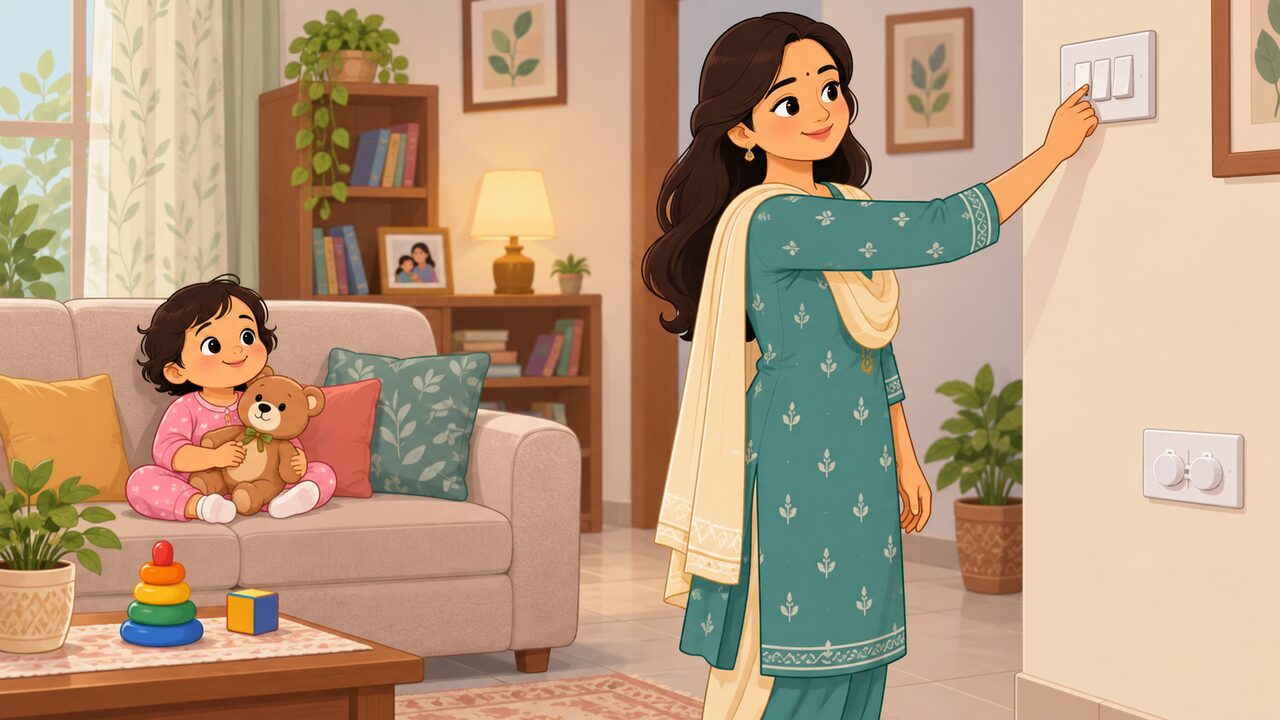
Quick answer: First switch off the power before you touch your child - pull the plug or turn off the main switch, and never touch a live wire or a child still connected to it with your bare hands. Then check breathing and alertness and call for help. Every child who gets a real electric shock needs a medical check the same day, even if they seem perfectly fine - electricity can injure the heart and other organs in ways you cannot see.
🟢 GREEN - Watching at home
- There is no true green zone for an actual shock from household current: any real shock from a wire, socket or appliance deserves a medical check today, because internal damage cannot be ruled out at home.
- A static-like spark (from a carpet or a car door) is not an electric shock and needs nothing.
🔴 RED - Call 108 NOW if
- Your child is unconscious, not breathing, or you cannot feel a heartbeat - start CPR immediately while someone else calls.
- Your child had a seizure, is confused, or has a burn or charred spot where the current entered or left.
- The shock involved water (a wet floor, bathroom, pool) or a high-voltage source.
- Your child fell after the shock or complains of neck or back pain - move them as little as possible.
- Any shock in a baby or toddler who cannot tell you what happened.
🆘 SOS - What to do right now, step by step
- Switch off the current first. Pull the plug or turn off the main switch before touching your child.
- If you cannot switch it off, move the child (or lift the wire off them) using a dry stick, a rolled-up newspaper or thick folded clothing - never your bare hands, or the current will pass into you.
- Move your child as little as possible - a severe shock can also injure the spine.
- Once the current is off, check breathing, heartbeat, colour and alertness. If your child is not breathing or has no heartbeat, start CPR immediately if you know how, and tell the 108 operator.
- Check for burns, especially where the current entered and left, and around the mouth if your toddler bit a cord.
❌ DO NOT
- Do not touch a child who is still in contact with the current - you will become the second patient.
- Do not assume a child who looks fine is fine - internal injury, especially to the heart, may not show immediately.
- Do not ignore a mouth burn from biting a cord: these are deeper than they look and can bleed hours or even days later - if bleeding starts, press a clean pad on it and get medical help immediately.
- Do not put ointments or home remedies on the burn marks.
What is happening and why
Electricity travels through the body along a path from where it enters to where it leaves, and it can injure the heart's rhythm and internal tissues along that path even when the skin shows only a small mark. That is why doctors want to examine and sometimes monitor every child after a real shock.
The common toddler scenarios are biting a cord and poking something metal into an uncovered socket - outlet covers, insulated wiring and keeping cords out of reach prevent almost all of them.
This page is for first-aid education and does not replace examination by a doctor. In an emergency, call 108 or 112.
Sources (last checked 13 Sep 2026)
- AAP, "Electric Shock Injuries in Children" (switch off first, never bare hands, minimal movement, CPR, every child needs a check, mouth-burn bleeding warning) - www.healthychildren.org/English/health-issues/injuries-emergencies/Pages/Electric-Shock.aspx
Approved for publication by Dr Anjana Alekhya, MD (Paediatrics) · Based only on AAP/IAP guidance · Published 13 September 2026