Something went into my child's eye - dust, an eyelash, or worse
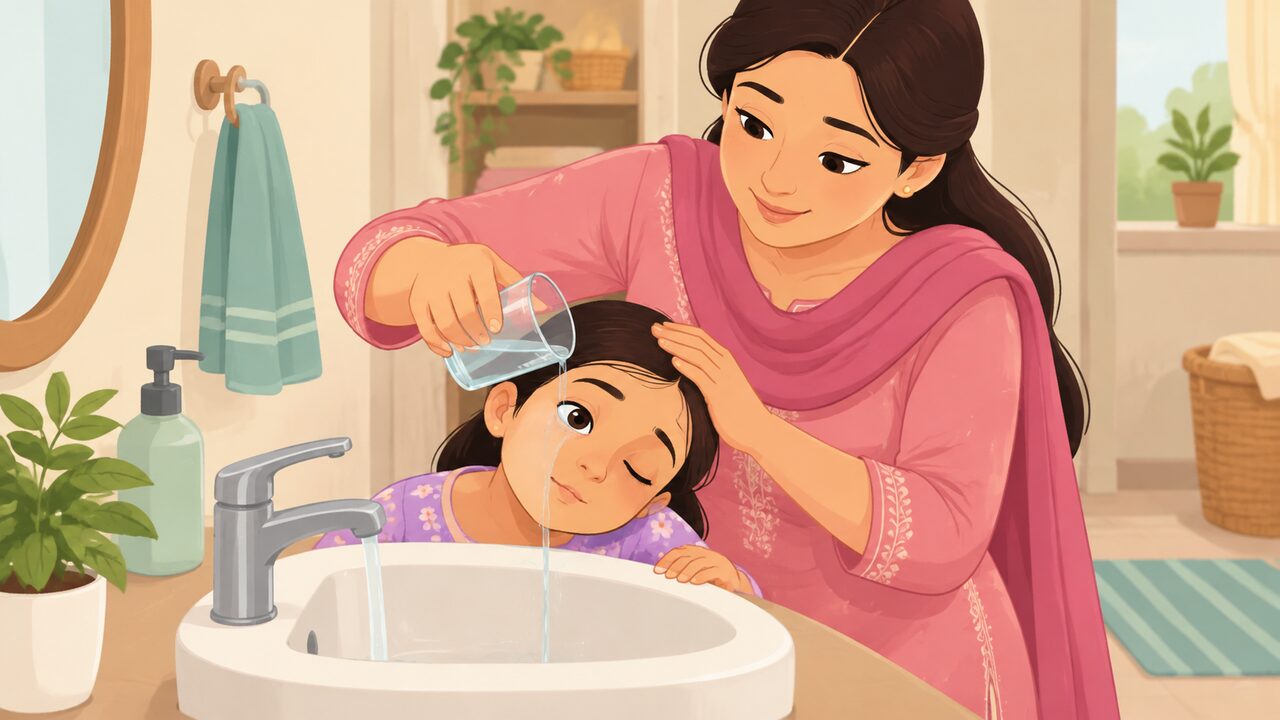
Quick answer: For dust, an eyelash or a small particle: let tears do the work - encourage blinking - and rinse the eye with clean water. Never let your child rub the eye. Go to the emergency room NOW if anything hit the eye at high speed, something is stuck on the eyeball (do not try to remove it), or a chemical splashed in - and for chemicals, flush with tap water immediately for at least 15 minutes, on the way too.
🟢 GREEN - You can usually manage at home when
- It is dust, an eyelash or small grit, and your child is tearing and blinking - tears wash most small particles out within minutes.
- Rinse the eye with clean running water, or put that side of the face in a pan of warm water and have your child open and close the eye under water several times.
- If the eye settles after rinsing, watch for the rest of the day.
🟡 YELLOW - Call your paediatrician today if
- Your child still feels something in the eye after a good rinse.
- Vision is not back to normal after rinsing.
- The eye stays red or painful, or your child keeps it shut.
🔴 RED - Go to the emergency room NOW if
- A chemical splashed into the eye - especially toilet, oven or drain cleaners, acids or alkalis, which can damage vision permanently. Flush with tap water at once and keep flushing on the way - at least 15 minutes.
- An object hit the eye at high speed - a metal chip from hammering, a stone from a mower, a glass fragment.
- An object is stuck on the eyeball or in the eyelid - cover the eye loosely and go; do not touch it.
- Tearing and blinking do not stop even after washing the eye out.
🆘 SOS - What to do right now
- Wash your hands first, and stop your child from rubbing.
- For a particle: rinse with clean water or blink the eye under a pan of warm water.
- For a chemical: start flushing with tap water immediately - every second counts - and continue for at least 15 minutes. Hold the eyelids open gently while you flush.
- Remove contact lenses (for an older child) only if they come out easily.
- Cover an injured eye loosely with a clean cloth or shield for the trip - no pressure on the eye.
❌ DO NOT
- Do not let your child rub the eye - rubbing turns a scratch into a deeper one.
- Do not try to remove anything stuck on the eyeball, and do not probe under the eyelid with cotton buds, tweezers or fingers.
- Do not use eye drops or ointments unless your doctor has advised them.
- Do not delay flushing a chemical eye to look up the product or find eye-wash solution - plain tap water, started immediately, is what saves vision.
What is happening and why
The eye's own defence is tears, and for ordinary grit that defence usually wins if you add clean water and keep small fingers from rubbing. The emergencies are about speed and force: strong chemicals keep burning the eye for as long as they sit there, which is why immediate, prolonged flushing matters more than anything else; and high-speed fragments can be embedded in the eye itself, which is why they must be left untouched for a doctor.
One comfort the AAP offers every anxious parent: nothing can roll behind the eye and get lost - the space behind the eyelids is a dead end.
This page is for first-aid education and does not replace examination by a doctor. In an emergency, call 108 or 112.
Sources (last checked 13 Sep 2026)
- AAP KidsDoc Symptom Checker, "Eye - Foreign Object" (rinse/blink advice; high-speed and stuck-on-eyeball = ER now) - www.healthychildren.org/English/tips-tools/symptom-checker/Pages/symptomviewer.aspx?symptom=Eye+-+Foreign+Object
- AAP KidsDoc Symptom Checker, "Chemical in eye" (immediate flushing is critical; strong chemicals can damage vision) - www.healthychildren.org/English/tips-tools/symptom-checker/Pages/symptomviewer.aspx?symptom=Chemical+in+eye
- AAP, "Poison Prevention & Treatment Tips" (rinse the eye for 15 minutes) - www.healthychildren.org/English/safety-prevention/all-around/Pages/Poison-Prevention-Tips.aspx
Approved for publication by Dr Anjana Alekhya, MD (Paediatrics) · Based only on AAP/IAP guidance · Published 13 September 2026