My child has a fever - when is it an emergency?
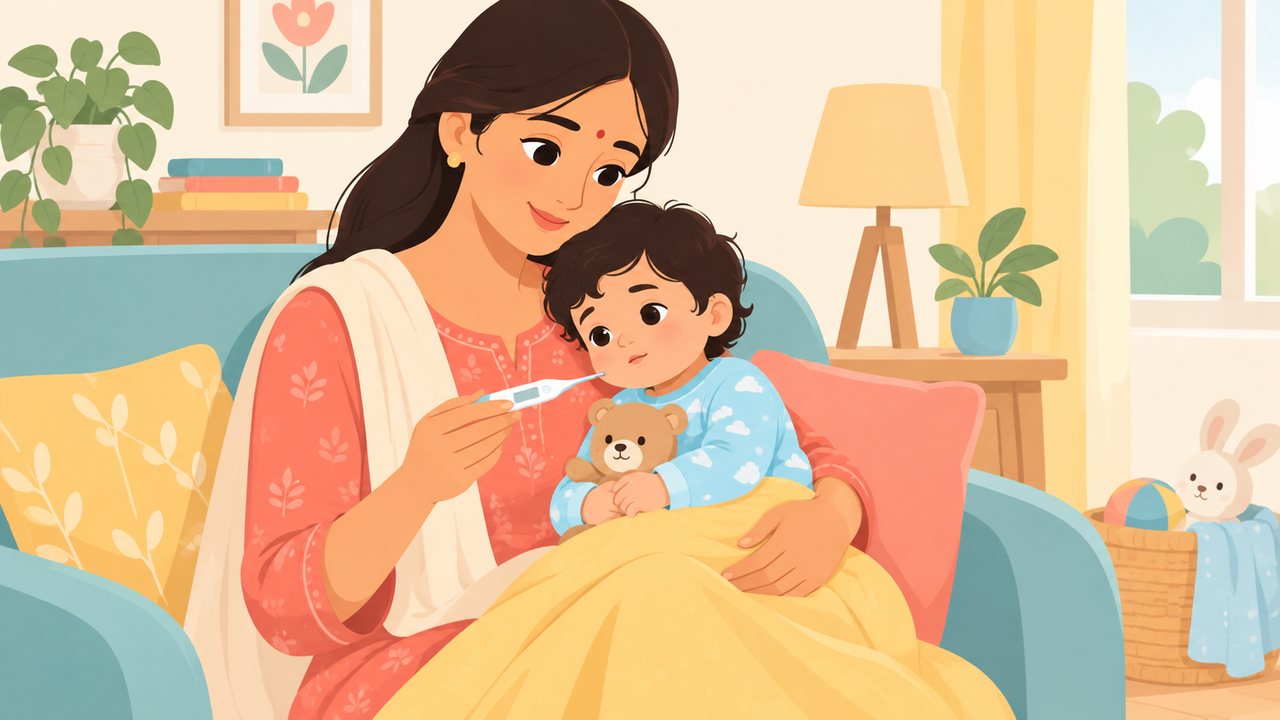
Quick answer: Fever itself is usually the body fighting an infection, and most fevers are not dangerous. The number matters less than how your child looks and behaves. The big exception: any baby under 3 months with a temperature of 38.0°C (100.4°F) or more needs a doctor immediately, even if they look fine.
🟢 GREEN - You can usually watch at home when
- Your child is over 3 months old, is drinking fluids, and plays or interacts with you (even if grumpy).
- The fever comes down with paracetamol and your child perks up after the medicine.
- It is a mild fever with a cold or cough and your child is otherwise acting close to normal.
Keep offering fluids often. Dress your child lightly. Check on them regularly, including at night.
🟡 YELLOW - Call your paediatrician today if
- The fever lasts more than 24 hours in a child under 2 years, or more than 3 days (72 hours) in a child 2 years or older.
- Your child still "acts sick" even after the fever comes down.
- Your child seems to be getting worse instead of better.
- Your child has a fever along with ear pain, sore throat, pain while passing urine, or any new symptom that worries you.
- Your child is between 3 and 6 months old with a temperature of 38.3°C (101°F) or more.
🔴 RED - Go to the emergency room NOW if
- Your baby is under 3 months old with a temperature of 38.0°C (100.4°F) or more. Do not give medicine first and watch - just go.
- Your child is unusually drowsy, difficult to wake, or confused.
- Your child has a seizure (fit). If it lasts more than 5 minutes, call 108.
- Your child has trouble breathing, or breathing that is much faster than normal.
- Your child has a rash that does not fade when you press it (press a clear glass against it - if the spots do not blanch, that is an emergency).
- Your child has a stiff neck or severe headache with the fever.
- Your child shows signs of dehydration: very little urine, no tears, dry mouth, refusing all fluids.
- The fever repeatedly rises above 40°C (104°F).
- Your child has a weakened immune system (cancer treatment, steroids, sickle cell disease, or other immunity problems) - a fever in these children is always urgent.
🆘 SOS - What to do while you get help
- Keep your child cool and lightly dressed. Do not bundle them up.
- Give small sips of water, ORS, milk or any fluid they will take.
- You may give paracetamol in the dose your paediatrician has told you for your child's weight. It eases discomfort; it does not treat the cause.
- If your child has a seizure, lay them on their side on a safe surface and time it. Do not put anything in their mouth.
❌ DO NOT
- Do not ignore a fever of 38.0°C or more in a baby under 3 months - this is the single most dangerous fever rule to break.
- Do not give aspirin to a child - it can cause a rare but serious illness (Reye's syndrome).
- Do not use cold-water baths, ice packs or alcohol rubs. They make children shiver and feel worse.
- Do not give antibiotics left over at home without a doctor's advice.
- Do not wait for a fever to "break on its own" if your child looks very unwell - trust what you see, not just the thermometer.
What is happening and why
Fever is a symptom, not a disease - it is the body turning up its thermostat to fight infection. Most childhood fevers are caused by common viral infections and settle in a few days. What doctors watch for are the few serious causes (like sepsis, meningitis, pneumonia or a urine infection), and those usually announce themselves through how the child looks and behaves: drowsiness, breathing trouble, refusing fluids, a non-blanching rash. That is why your child's behaviour matters more than the exact number.
For babies under 3 months, the rules are stricter because their immune systems are new and they cannot show clear signs. The American Academy of Pediatrics has a dedicated guideline for fever in babies 8 to 60 days old, and those babies need blood and urine tests to rule out serious infection even when they look well.
This page is for first-aid education and does not replace examination by a doctor. In an emergency, call 108 or 112.
Sources (last checked 13 Sep 2026)
- AAP, "Fever: When to Call the Pediatrician" - www.healthychildren.org/English/health-issues/conditions/fever/Pages/When-to-Call-the-Pediatrician.aspx
- AAP, "Fever and Your Baby" - www.healthychildren.org/English/health-issues/conditions/fever/Pages/Fever-and-Your-Baby.aspx
- AAP, "Infant Fever" (2021 clinical practice guideline, febrile infants 8-60 days) - www.aap.org/en/patient-care/infant-fever/
- AAP, "Fever Without Fear: Information for Parents" (alcohol baths/ice packs no longer recommended) - www.healthychildren.org/English/health-issues/conditions/fever/pages/Fever-Without-Fear.aspx
- AAP, "A Parent's Guide to Over-the-Counter Medicines for Children" (aspirin/Reye's syndrome warning) - www.healthychildren.org/English/safety-prevention/at-home/medication-safety/Pages/Choosing-Over-the-Counter-Medicines-for-Your-Child.aspx
Reviewed and approved by Dr Anjana Alekhya, MD (Paediatrics) · Published 13 September 2026