My child has a cut that is bleeding a lot - pressure first, everything else second
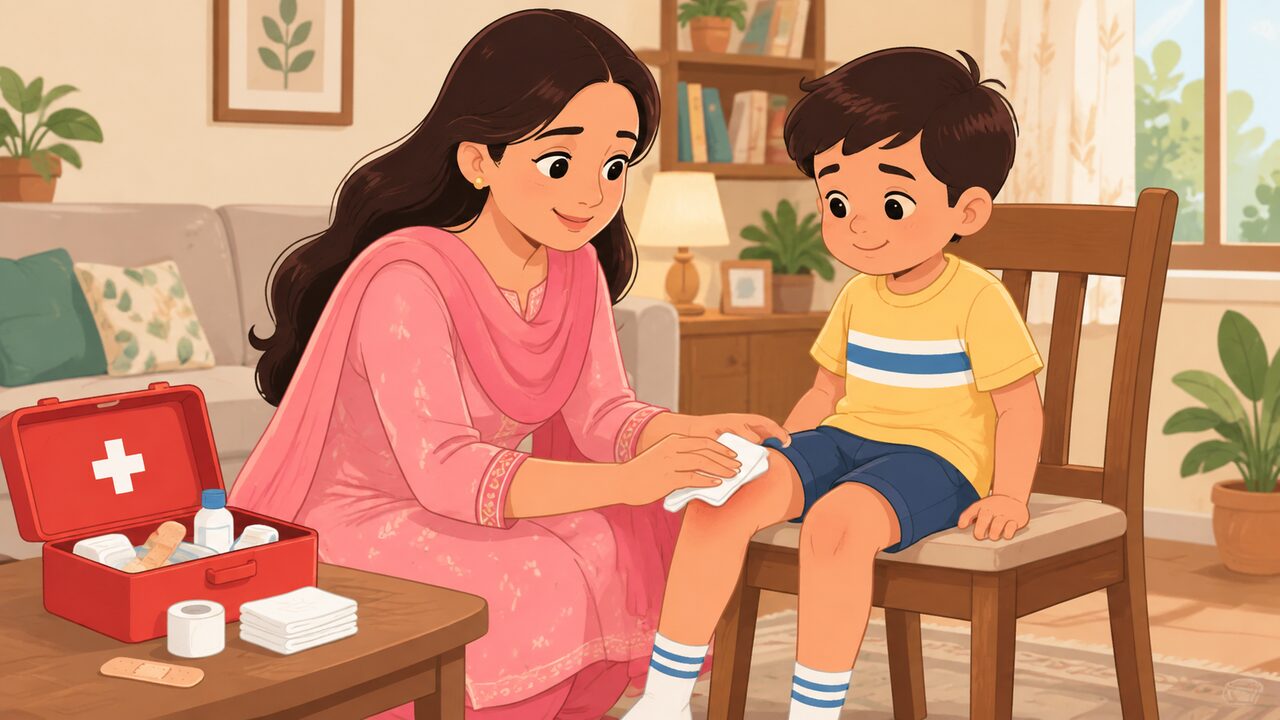
Quick answer: Press a clean cloth or gauze pad firmly on the wound and hold it there for 5-10 minutes - do not lift it to peek, because that is the most common reason bleeding continues. Almost all bleeding stops with direct pressure. If blood is flowing or pulsing out, or soaking through, call 108 immediately and keep pressing hard with both hands.
🟢 GREEN - You can usually manage at home when
- Bleeding stops within 5-10 minutes of firm pressure, and the cut is small, shallow, closed (not gaping) and clean.
- Once bleeding stops, gently wash the wound with soap and water for about 5 minutes - good cleaning lowers the chance of infection and of dark marks from dirt left in the skin.
- Cover with a clean plaster or dressing and watch over the next days for increasing redness, swelling, warmth, pus or fever.
🟡 YELLOW - Call your paediatrician today if
- The cut is deep, gaping, or longer than about 1 cm (half an inch) - it probably needs stitches or skin closure, and sooner is better for healing and scarring.
- The cut is on the face or another cosmetically sensitive area.
- The cut came from a bite, a rusty or dirty object, or still has dirt or glass in it after gentle washing.
- Your child's tetanus vaccination is not up to date.
🔴 RED - Call 108 NOW if
- Blood is flowing or pulsing out of the wound - heavy bleeding can become life-threatening within minutes. For a small child, even a few tablespoons of blood loss matters.
- Bleeding continues heavily despite 10 minutes of firm direct pressure.
- The wound is very large or deep, or you can see fat, muscle or bone.
- Your child is pale, sweaty, drowsy or faint.
🆘 SOS - What to do right now, step by step
- Find exactly where the blood is coming from, place clean gauze or a clean piece of clothing directly on it, and press down firmly with both hands, one on top of the other - lock your elbows and use your body weight.
- Keep pressing. If blood soaks through, do not remove the first pad - add pressure again on top of it.
- If bleeding from an arm or leg still will not stop, a tourniquet placed 2-3 inches above the wound (not over a joint), tightened until the bleeding stops, can save a life - a wide cloth band works if nothing else is available. Note the time and tell the ambulance team.
- Keep your child lying down and warm while you wait.
❌ DO NOT
- Do not keep lifting the cloth to check - every peek restarts the bleeding.
- Do not remove a soaked pad - press on top of it.
- Do not probe the wound or pull out large embedded objects - press around them and let the doctors remove them.
- Do not apply a tourniquet for ordinary bleeding - direct pressure handles almost everything; a tourniquet is only for limb bleeding that pressure cannot stop.
- Do not give food or drink if stitches or surgery may be needed.
What is happening and why
Bleeding stops when a clot plugs the broken vessels, and firm uninterrupted pressure holds everything in place while that clot forms - which is why peeking undoes your work. Stitches are time-sensitive: a gaping cut closed within hours heals faster and scars less, especially on the face.
Genuinely severe bleeding - the kind that flows, pulses or will not stop under pressure - is one of the few injuries where minutes decide the outcome, and the AAP's guidance mirrors the Stop the Bleed teaching: call for help first, then press hard and do not stop.
This page is for first-aid education and does not replace examination by a doctor. In an emergency, call 108 or 112.
Sources (last checked 13 Sep 2026)
- AAP, "Treating Cuts, Bleeding and Scrapes in Children" (5-10 min direct pressure, wash 5 min, stitches guide, severe bleeding steps, tourniquet for unstoppable limb bleeding) - www.healthychildren.org/English/health-issues/injuries-emergencies/Pages/Treating-Cuts.aspx
Approved for publication by Dr Anjana Alekhya, MD (Paediatrics) · Based only on AAP/IAP guidance · Published 13 September 2026